Be yourself; Everyone else is already taken.
— Oscar Wilde.
This is the first post on my new blog. I’m just getting this new blog going, so stay tuned for more. Subscribe below to get notified when I post new updates.
Be yourself; Everyone else is already taken.
— Oscar Wilde.
This is the first post on my new blog. I’m just getting this new blog going, so stay tuned for more. Subscribe below to get notified when I post new updates.
Rebecca Pinner’s 2010 dissertation entitled “St: Edmund, King and Martyr: Constructing his Cult in Medieval East Anglia” is a helpful, though gentle, pushback against the predominant scholarship surrounding Edmund and medieval saints’ cults in general. Pinner is familiar with a vast array of scholarship on saints but finds particular inspiration from Virginia Blanton’s “horizontal” work on the cult of St. Æthelryth of Ely. Simply put, Pinner hopes that broader investigations into cults that focus less on trying to find the truest account of a particular saint’s life and more on examining the cult from all angles will yield more useful views into life in the middle ages and insight into the nature of cults. She uses Edmund as her case study, claiming that, “Edmund’s historical indeterminacy, which has so troubled historians, was in fact his greatest asset, enabling successive generations of devotees to redefine Edmund to suit their own proclivities and requirements and ensuring his enduring appeal.”[1] She critiques other scholar’s tendency towards oversimplification, both of general investigation into cults and particularly with St. Edmund.
Pinner’s twofold argument is intrinsically connected with her approach. Her investigation into Edmund, with its internal critiques, is simply an example as to how she thinks hagiographical inquiry ought to be done. Her principal argument is that one ought to use literature, art history, social history, and anthropology in the investigation into the cult of saints, rather than looking at the compartments of hagiography, miracle collections, and pilgrimage activity. Context is key, and she fears that even though focusing on one of the three traditional emphases might make sense for simplicity’s sake, such reductionistic methodology creates a narrow picture of the cult of saints that impairs the modern scholar from truly understanding religion and culture in the Middle Ages. She clearly explains each of her categories of inquiry, though admittedly most of her work comes from art history. The idea of the created thing that leaves the mark of a particular person in history is in full effect, and she does her job well in terms of trying to determine why particular images and texts were created, what they were used for, who would have used them, etc.
Her selection of Edmund, in particular, was to illuminate how the varying modes of inquiry might yield a plethora of insights, because Edmund was such a varied character. She toys with, and finally denounces, John Lydgate’s tripartite epithet ‘martir, maide, and king.’ Calling for nuance in each of the categories. She looks at Bury, his cult’s epicenter, as well as other areas in East Anglia, to piece together what life would have been like in the time Edmund died and past that. Of particular interest is the continual threat of Viking (Danish) invasion, and the psychosocial effect that would have had on East Anglians. Her insights into the significance of male virginity are profound when so much hagiographical scholarship on virginity focuses on females. She greatly illustrates the parallelism between Edmund’s constructed martyrdom and Christ’s sacrifice, showing that bit of the narrative to be as significant for clergy as Edmund’s head’s call of “hīc, hīc, hīc,” to his fellow East Anglians from between the legs of the wolf, which would have been significant to his people. Pinner leaves you thinking, “No wonder he had once been England’s patron saint.”
Although Pinner critiques other scholarship, what she is doing is critiquing a hyper fixation. Her work cannot exist without other scholars trying to investigate St. Edmund himself. Although she advocates what she believes to be a new methodology, it must be a broadening of an existing one; adding something new, while keeping what was already in place. In her attempt to say she is adding something distinctly new to the conversation, she sometimes dismisses good scholarship just because it seems too in the vein of a search for a historical person, such as Grant Loomis’ “The Growth of the Saint Edmund Legend”. There is the implication that these scholars waste their time doing guesswork that others have already tried their hand at and will never yield the full truth. What she hopes for seems to be a reorientation of spare resources. These resources (human, financial, historical, etc.), which currently in the majority focus on finding “the truth” on particular saints’ lives, should shift and instead focus on cultural interactions. To Pinner, trying to find the reality of Edmund’s life is nearly a lost cause, though such investigations do produce valuable information. Still, though Pinner’s art-historical preoccupation might yield good insight into the medieval mind, there are some concerns. If done well, art history can yield profound cultural insight. Done poorly, without enough research, it is a mess of conjecture. Pinner’s work for Edmund provides a lot of wonderful insight into the varying instances of Edward in East Anglia, but even then, one can only glean so much without dipping into guesswork that “sounds right”. Still, that criticism can be applied to much of hagiography due to its historically ambiguous nature. I do not want to discount this approach but qualify it.
Pinner’s argument in both the particulars and the broader scale is generally well-executed. There are broader veins of investigation that have been ignored thus far into the cult of saints that would yield a more holistic view of medieval Europe and England. Still, she would do well to use the humility topoi rather than claim her approach to be altogether new. Her critiques on the inability of certain veins of hagiographical scholarship to ever achieve truth are valid, and yet I find myself tempering support for her ideas because 1) her solution seems susceptible to the same pitfalls, and 2) there might be a different intention for their scholarship from her own. Considered on its own, some of Pinner’s claims seem harsh, but in the greater mix of scholarship on the cult of saints, they contain a valuable approach that other scholars would do well to implement.
[1] Rebecca Pinner, “St: Edmund, King and Martyr: Constructing his Cult in Medieval East Anglia,” PhD diss., (University of East Anglia, 2010), 375.
My saint is St. Edmund, also called Edmund the Martyr or Edmund of East Anglia. Although little contemporary work survives in the modern day on Edmund due to Viking raids and later the Dissolution of the monasteries, some work still survives due to his importance. He was a prevalent saint, considered to be the patron saint of England during the Middle Ages. He is first mentioned in an annal of the Anglo-Saxon Chronicle twenty years after his death. He is supposed to be the son of Æthelweard, though there is debate on who his father was or what royal lineage he was part of. He is supposed to have died on the 20th of November, 869.
There is not a perfect consistency to his depiction, though certain themes are common. In hagiographical art, these small motifs are important to clue people in to know which saint they are looking at. It was interesting to see how these depictions both varied and stayed consistent across time and place.
I found a number of depictions of St. Edmund from various time periods of history. These incredible pieces show different versions of Edmund- saint, martyr, king. The first work I found was an illumination from a medieval manuscript.
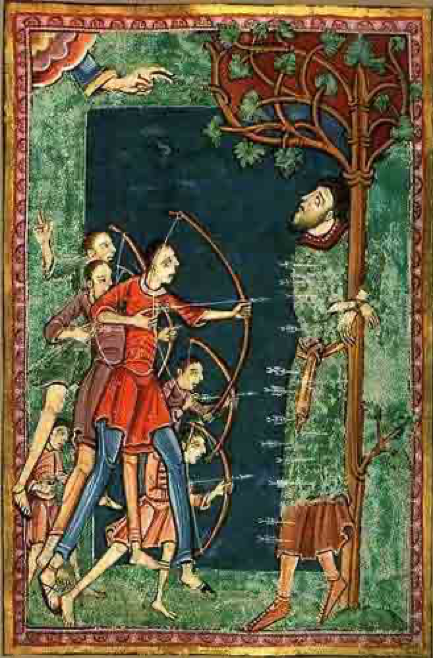
St. Edmund is pictured helpless, tied to a tree, with a dozen arrows protruding from his body from his assailants. He is looking up towards heaven, and hands can be seen reaching down. He is wearing a simple green cloak with a purple-y collar. Perhaps the purple shows his royalty, but all in all, what is emphasized here is humility, not royalty. I was not able to find a place, date, or author from this piece.
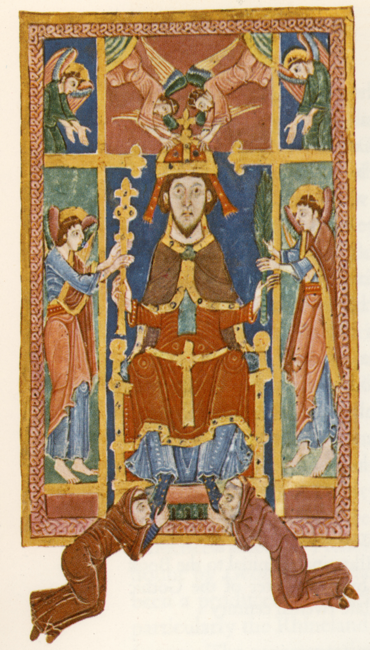
This second depiction of St. Edmund is wildly different from the first one. It is called “St. Edmund the Martyr crowned by angels”. This piece comes from a manuscript of Bury St. Edmunds (a church dedicated to him in Bury), around 1130. In this work, Edmund is surrounded by angels and gold. He has a magnificent crown and what looks like a bejeweled scepter, sitting on a throne. It emphasizes so heavily his regality and power, and even his God-given role as ruler.
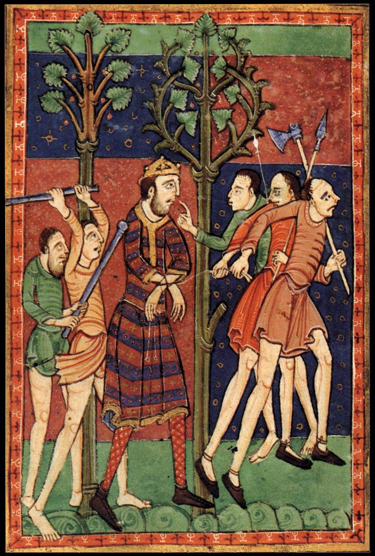
This third depiction is similar in some ways to each of the prior ones. The scene is of part of his martyrdom, like the first one, though it shows him right before his beheading rather than being shot with arrows. His hands are bound, just like before, and his demeanor and expression still show humility. Still, he is shows with gold on his tunic, and he is wearing his crown. His clothes are embroidered, and it shows his status as king as well as martyr. It is from Bury around 1130.
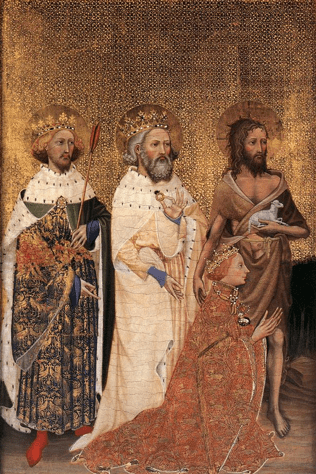
This image depicts Edmund alongside Edward the Confessor, John the Baptist and Richard II. He is differentiated not by his crown (three of them are royal), but by the single arrow his left hand is clutching. This is called the Wilton Diptych, from 1395, painted as a portable altarpiece for King Richard II by a Frenchman.
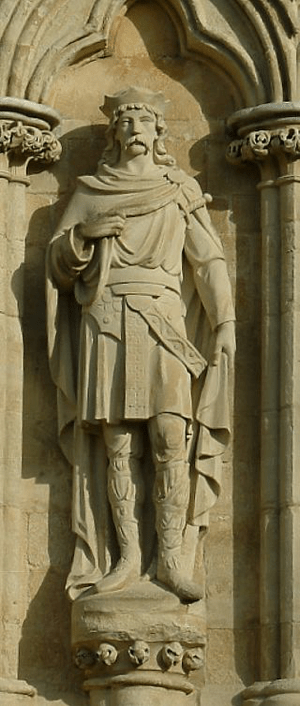
This stature is from the West Front of Salisbury Cathedral. It shows plainly to the common man Edmund’s regality. I could not find a date, but many of these statues on the West Front are from the 1800s.
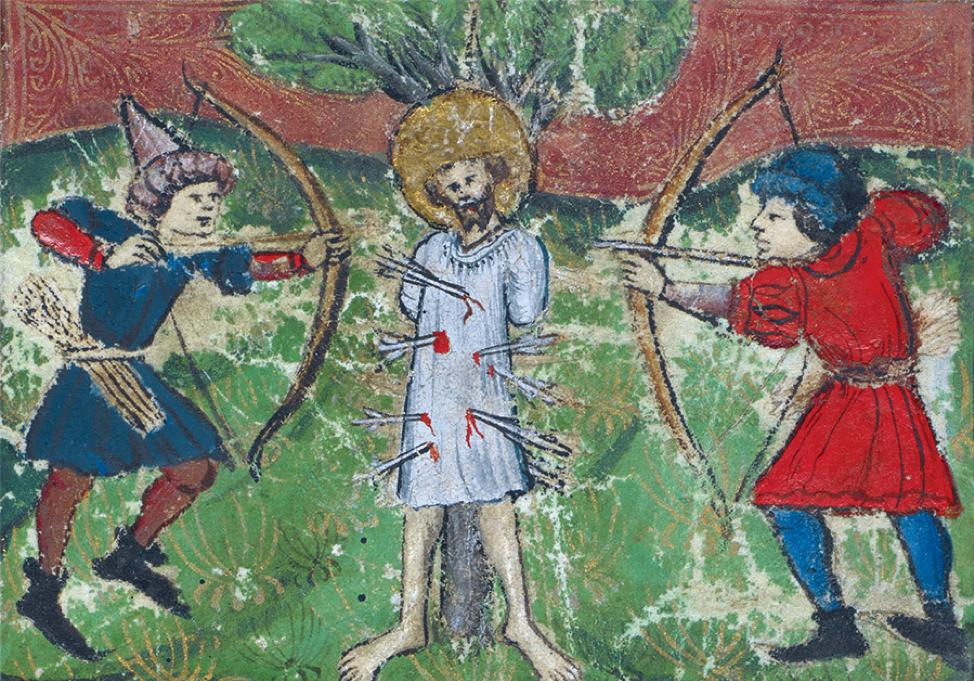
This is miniature is from c.1450. He has a plain undergarment, peppered with arrows, and a nimbus. I cannot tell if there is a crown due to the fade.

Here is a typical Orthodox icon of St. Edmund. The crown, sword, and cloak show him as king, and he is shows with the arrow.
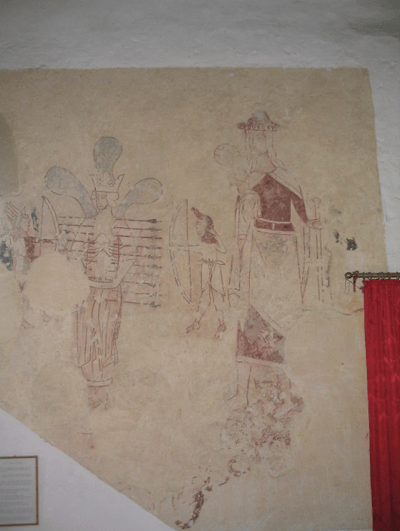
Here is a depiction of Edmund’s martyrdom with a wall painting at Stoke Dry, in Rutland. You can see the crown and the arrows, despite the weathered stone.
Amiet, R. “Le Calendrier Liturgique Du Diocèse de Périgueux (1548-1559).” Bulletin de La Société Historique et Archéologique Du Périgord, no. 3 (1988): 121. https://search.ebscohost.com/login.aspx?direct=true&AuthType=shib&db=edscal&AN=edscal.11940174&site=eds-live.
——. “Un Missel de La Collégiale Saint-Front de Périgueux (XIe Siècle).” Bulletin de La Société Historique et Archéologique Du Périgord, no. 4 (1991): 609. https://search.ebscohost.com/login.aspx?direct=true&AuthType=shib&db=edscal&AN=edscal.6562105&site=eds-live.
Coad, Jenny. “PERIGUEUX; With Its Turreted Cathedral, Busy Markets and Pretty Streets, the Dordogne’s Capital Is All about the Good Life, Says Jenny Coad.” Sunday Times (London, England), 2020. https://search.ebscohost.com/login.aspx?direct=true&AuthType=shib&db=edsgit&AN=edsgit.A615784048&site=eds-live.
Gibson, Ralph. “Rigorisme et Liguorisme Dans Le Diocèse de Périgueux XVIIe-XIXe Siècle.” Revue d’histoire de l’Église de France, no. 195 (1989): 315. doi:10.3406/rhef.1989.3474.
Grabar, André. “Saint-Front de Périgueux et Le Chevet-Martyrium.” Orientalia Christiana Periodica 13, no. 3–4 (1947): 501–8. http://search.ebscohost.com/login.aspx?direct=true&AuthType=shib&db=rfh&AN=ATLA0001399308.
Herrick, Samantha K. “Studying Apostolic Hagiography: The Case of Fronto of Périgueux, Disciple of Christ.” Speculum 85, no. 2 (April 2010): 235–70. doi:10.1017/S0038713409991023.
Labarre, Sylvie. Le Manteau Partagé: Deux Métamorphoses Poétiques de La Vie de Saint Martin Chez Paulin de Périgueux (Ve s.) et Venance Fortunat (VIe S.). Collection Des Études Augustiniennes Série Antiquité 158. Paris: Institut d’études augustiniennes (Brepols distributor], 1998. http://search.ebscohost.com/login.aspx?direct=true&AuthType=shib&db=rfh&AN=ATLA0001431084.
Paulinus of Perigueux. United Kingdom, 1985. https://search.ebscohost.com/login.aspx?direct=true&AuthType=shib&db=edseul&AN=edseul.3000087119744&site=eds-live.
“Perigueux: St. Front Cathedral Int: Cloister,” 1120. https://search.ebscohost.com/login.aspx?direct=true&AuthType=shib&db=edsart&AN=edsart.ARTSTOR.103.41822000017846&site=eds-live.
Roux, Joseph. “La Basilique St.-Front de Périgueux. Ses Origines et Son Histoire Jusqu’en 1583,” 1920. https://search.ebscohost.com/login.aspx?direct=true&AuthType=shib&db=edsbas&AN=edsbas.E543F182&site=eds-live.
“Saint-Front, Périgueux Plan,” 1120. https://search.ebscohost.com/login.aspx?direct=true&AuthType=shib&db=edsart&AN=edsart.KOHL.HISTORY.1039765357&site=eds-live.
Stones, Alison. “Périgueux”. Oxford: Oxford University Press, 2010. EBSCOhost, doi:10.1093/gao/9781884446054.article.T2089346.
The location I chose for 3.1 is Perigueux, France. This is on the Venezelay route through France. This is the resting place of St. Fronto.
I first looked up the Perigueux Cathedral on Wikipedia, and then the city of Perigueux on Wikipedia. I then looked up the Perigueux diocese on a catholic website, because I was struggling to find information on the cult history elsewhere.
PreChristian Significance: “The name Périgueux comes from Petrocorii, a Latinization of Celtic words meaning “the four tribes” – the Gallic people that held the area before the Roman conquest. Périgueux was their capital city. In 200 BC, the Petrocorii came from the north and settled at Périgueux and established an encampment at La Boissière.” From Wikipedia link 2.
Romans took over after them and added temples, baths, amphitheaters, and a forum.
Saint of Devotion: St. Front (or Fronto), feast day October 25. He is called Bishop and Confessor.
Legends of Founding: Fronto brought his companion back to life and preached the gospel in Perigueux. “Blessed Fronto recovered his companion from death, using the staff of the Apostle, and converted the aforementioned city, through his preaching, to Christ. He went all over with many miracles, and died with dignity there, buried in the basilica built in his name and in which, through the munificence of God, many benefits are given to those who ask. Some traditions say he was a disciple of the brotherhood of Christ. His tomb is not like that of other saints; it is made with the greatest devotion as a rotunda, like the tomb of the Lord, and is more beautifully worked than all the tombs of other saints.” From Liber Sancti Iacobi.
Additionally, “Subsequent biographies, which appeared between the tenth and thirteenth centuries, make St. Front’s life one with that of St. Fronto of Nitria, thereby giving it an Egyptian colouring.” From Catholic Encyclopedia
Translation/Invention: “Pierre Raoul or Gérard, a parish priest in Périgord, brought back after the First Crusade the Holy Shroud of Christ, entrusted to him by a dying ecclesiastic of Le Puy, who himself obtained this relic from the legate Adhémar de Monteil.” From Catholic Encyclopedia
Special Practices/Liturgies: The Church of Perigueux is the only one in France to celebrate Charlemagne’s feast day (January 28). From Catholic Encyclopedia
“The Holy See instituted a confraternity in honour of the Holy Shroud, thought to be the oldest in France. ” From Catholic Encyclopedia.
It was a 5th century site of a school with distinguished professors. From Catholic Encyclopedia.
Surviving Art/Historical/Architectural Monuments: “The Cistercians who founded the monastery of Cadouin in 1115 had a church erected in honour of this relic; its cloister, a marvel of art, was consecrated in 1154. Notwithstanding the strict rules of the order interdicting the use of gold vases, the Chapter of Cîteaux permitted a gold reliquary for the Holy Shroud.” From Catholic Encyclopedia
The church is mainly rebuilt now in the late 1800s. From Wikipeda link 1.
Choose an invention/translation account from the period c. 800-1100 from Geary’s Appendix.
My Saint: St. Severus, Bishop of Ravenna
Evidence in the BHL, Acta Sanctorum, etc.:
BHL 7681, 7682. In Brussels and Trier. No English Translation available.
Acta Sanctorum: Located. Feast Day Feb 1. Section 3 is a Transaltio. Entitled Severi Translatio, cultus apud Germanos, page 81 of first February link in Acta Sanctorum.
Account Summary:
Online accounts are varied. The date of relic translation is commonly identified as 836. If I could translate the latin translatio in the Acta Sanctorum, that would be nice. In the Oxford Cults of Saints in Late Antiquity project, there is a link with ID EO5789 for evidence of a translation by Agnellus of Ravenna. However, this identifies the writing of the account from 830-846, and the translation around 500. Perhaps there are two translations, as noted vaguely in the catholic wiki site that I looked at, and the latter translation falls out of their timeframe (they stop at 700).
‘After the loss of blessed Peter, this one [John II, Bishop of Ravenna, 578-590] finished the incomplete work which he had left, that is, the church of St Severus, and brought it to completion, and he dedicated the body of St Severus the confessor in the middle of the temple … he decorated it in appearance with wonderful size. The holy body was taken up by him from the monasterium of St Rophilius, which is attached to the side of this church, on the men’s side, and he placed it in the middle of the church.’
http://csla.history.ox.ac.uk/record.php?recid=E05789
Text: Deliyannis 2006. Translation: Deliyannis 2004.
All in all, I feel very confused and would like a better handle on the Latin to look at the Acta Sanctorum.
Notes towards a critical study of St. Vitus’ cult
Earliest pieces of evidence for cult:
Do they exist in translation:
-What aspects of cult exist?
-What threads of interest can I find?
This blog post will show an accumulation of texts written that concern Saint Vitus in some capacity. They come chiefly from databases I have access to (JSTOR, ATLA, ITER). Chicago style, as best as WordPress allows. Pity I could not figure out the indentations.
Bibliography
Bravermanová, Milena. “Archaeological Textiles from Prague Castle, Czech Republic.” In North European Symposium for Archaeological Textiles X, edited by Strand Eva Andersson, Gleba Margarita, Mannering Ulla, Munkholt Cherine, and Ringgaard Maj, 31-35. Oxford; Oakville: Oxbow Books, 2010.
— — — . “The Collection of Archaeological Textiles at Prague Castle.” In Northern Archaeological Textiles, edited by Pritchard Frances and Wild John Peter, 93-97. Oxford: Oxbow Books, 2005.
Cílek, Václav, Evan W. Mellander, Morna Livingston, and Laurie Olin. “The Breath of Bones and Places.” In To Breathe with Birds: A Book of Landscapes, 83-98. Philadelphia: University of Pennsylvania Press, 2015.
Dickason, Kathryn Emily. “Decadance in the Late Middle Ages: The Case of Choreomania.” In Medieval Theatre Performance: Actors, Dancers, Automata and Their Audiences, edited by Butterworth Philip and Normington Katie, 141-60. Woodbridge, Suffolk, UK; Rochester, NY, USA: Boydell and Brewer, 2017.
Kalina, Pavel. “Architecture and Memory. St. Vitus’s Cathedral in Prague and the Problem of the Presence of History.” In Art as An Instrument of Rule: Bohemia and the Holy Roman Empire Among the Luxembourgers In a European Context, edited by Jiri Fajt and Andrea Langer, 150-56. Berlin: German Art Publisher, 2009.
Kottje, Raymund. “Library as a Mirror into History: On the Inner History of Gladbach’s St. Vitus Abbey in the 12th Century.” Treatises – Bavarian Academy of Sciences. Philosophical-Historical Class, New series, vol. 99, (1988). 241-48.
Maskarinec, Maya. City of Saints: Rebuilding Rome in the Early Middle Ages. Philadelphia, PA: University of Pennsylvania Press, 2018.
Miladinov, Marina. “PREFACE.” In Saints of the Christianization Age of Central Europe: Tenth to Eleventh Centuries, edited by Klaniczay Gábor, by Gaşpar Cristian and Wood Ian, 19-26. Budapest, Hungary: Central European University Press, 2013.
Milorad, Ekmečić. “The Emergence of St. Vitus Day as the Principle National Holiday of the Serbs.” In Kosovo: Legacy of a Medieval Battle, edited by Wayne Vucinich and Thomas Emmert, 331-42. Minneapolis, MN: University of Minnesota Press, 1991.
Piqué, Francesca and Dusan Stulik, ed. Conservation of the Last Judgement Mosaic, St. Vitus Cathedral, Prague. Los Angeles, CA: Getty Conservation Institute, 2004.
Rice, Louise. “Two Scenes from the Life of St. Wenceslas by Giovanni Battista Gaulli.” Master Drawings 44, no. 2 (2006): 221-28.
Šedinová, Hana. “The Symbolism of the Precious Stones in St. Wenceslas Chapel.” Artibus Et Historiae 20, no. 39 (1999): 75-94.
Strasser, Gerhard F. “Saint Vitus, the Vitus Dance and Those Bitten by the Tarantula.” In Rulers: Heroes, Saints: Medieval Myths, Vol. 1, edited by Ulrich Müller and Werner Whimsical, 557-65. St. Gallen, Switzerland: UVK, Specialist Publisher for Science and Studies, 1996.
Suckale, Robert. “Bohemian Master, c. 1390/1400. Master of the St. Vitus Madonna.” In Masterpieces of Western Art: A History of Art In 900 Individual Studies, Vol. 1, by Ingo F. Walther, 71. Taschen, Cologne: Taschen Publisher, 1996.
Whitfill, Patrick. “The Dancing Plague.” The Threepenny Review 145 (2016): 5.
Bibliography of Relevant Texts, according to the BHL (Bibliotheca Hagiographica Latina). Each entry will start with the BHL Number, and then the title.
8711: Passio
8712: Passio
8712b: Passio
8712d: Passio
8713: Passio
8713b: Passio
8713d: Passio
8713f: Passio
8714: Passio
8715: Passio
8715b: Passio auct. Johanne Garzone
8716: Passio auct. Tutone mon. Tharisiensi
8717: Translatio Marianum an. 801
8718: Translatio Corbeiam in Saxonia an. 836
8719: Translatio Corbeiam in Saxonia an. 836
8719a: Translatio Corbeiam in Saxonia an. 836
8720: Epitome
8721: Carmen
8721b: Miracula SS. Viti et Modesti apud S. Andream in Lavent an. 1223
8721d: Vita metrica
8721m: Sermo in inventione reliquiarum SS. Viti, Cornelii, Cypriani et aliorum in Gladbach
8722: Translatio Pragam an. 1355 (e=Epistula Caroli IV imp.)
8723: Inquisitio facta Senis an. 1355 de servato Pragae corpore S. Viti (immo S. Guidonis de Amanannia)
Vitus: Textus (s.n.)
Under BHL 8711, I was able to locate a large number of editions from various cities. The earliest ranges from 801 to 901 in Paris. The second earliest is from 851-950, in the Vatican, which I used to locate the actual Vatican scanned entry of Vitus’ Passio.
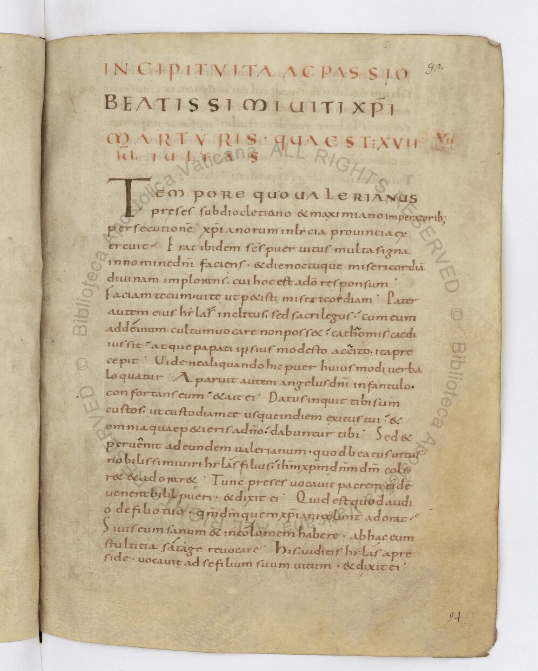
Other entries come from various French cities, Cologne, Namur, Copenhagen, The Hague, etc.
I struggled to locate an English translation for his Passio.
The Oxford Cult of Saints in Late Antiquity project has accumulated a few documents on Vitus.
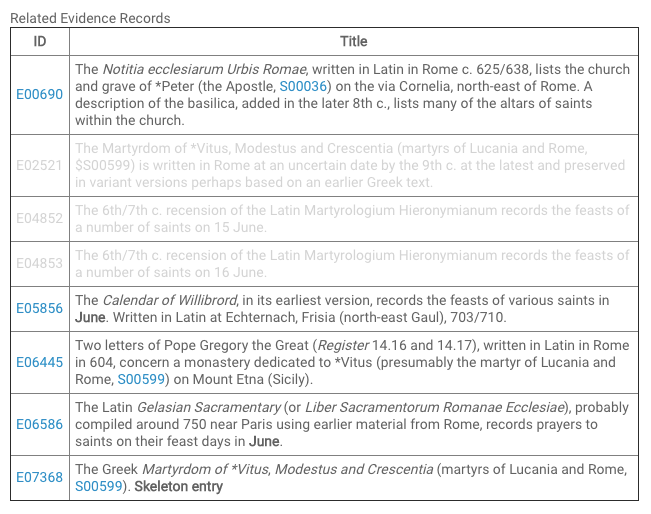
Sadly, they do not yet have an English translation of his Passio, but there is mention of him in Rome and Sicily which holds weight in establishing where he might have had medieval cult followings.
I had to click on a few different tomes of the Acta Sanctorum to find my saint, but I eventually located Vitus in tomes 2. His feast day is June 15, which was the last day in tome 2. He was all the way down on page 1013 of the document, page 1135 on the link. He is accompanied in the Acta Sanctorum by Modestus and Crescentia, his tutor and nurse, respectively, as indicated by the header: De SS. Vito, Modesto, Crescentia, MM.
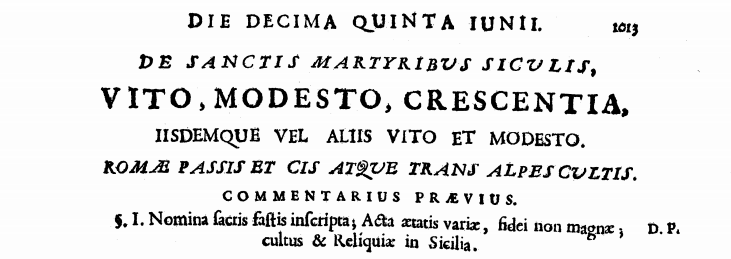
Outline of the Acta Sanctorum on St. Vitus
De Sanctis Martyribus Siculis, Vito, Modesto, Crescentia, iisdemque vel aliis vito et modestto. Romae passis et cis atque trans alpescultis. Commentarius prævius.
I. Nomina sacris sastis inscripta; Aeta ætatis variæ, fidei non magnae; cultus & Reliquiæ in Sicilia.
II. Cultus & Reliquiæ S. Viti & fociorum in Italia. Historia translatorum in Apuliam eoporum.
III. Reliquiæ & Cultus S. Viti in Provinciis Transalpinis
PASSIO S. VITI
Seculo vi vel vii composita, & Romæ inventa seculo viii. Ex variis Codicibus Mss. Admonitio prævia D.P.
Pars 1. A S. Vito aeta & tolerata in Sicilia, sub patre Hyla & Praeside Valeriano.
Annotata D.P.
Pars II. Transitus in Lucaniam, inde romam. Varia panæ inflictæ. Obitus. Sepultra.
Annotata D.P.
D.P. Disquisitio Conjecturalis. De Prima sepultra S. Viti, & prætensa Translatione corporis ex Lucania in Apuliam.
Translatio S. Viti
Roma in Franciam & inde in Cotbejam Saxonicam: Auctoribus eorumden locorum Monachis duobus. Ex Mss. Gladbacensi & Bodecensi.
Prologus.
Caput I. Reliquiæ S. Viti in Franciam translatæ, & pro novæ Corbiæ in Saxonia structo monasterio, petitæ atque impetratæ.
Annotata G.H. ET D.P.
Caput II. Translatio S. Viti ad Corbejam-novam miracula per iter.
Annotata G.H. & D.P.
Translatio S. Viti
Ex Italia in Bohemiam sub Carolo IV.
I. Litterae de ea re Imperiales, & quæstio habita de corpore, quod Senis esse dicebatur, est autem S. Guidonis alicujus.
L.S. Per Dominum Regem. Nicolaus de Chremschiz.
II. Analeeta de Gloria Ecclesiæ S. Viti Pragæ.
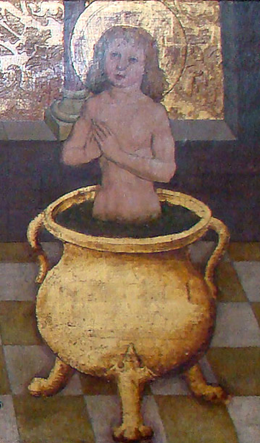
Martyrdom of Saint Vitus, Germany circa 1515, St. Vitus church, Flein. From Wikipedia, link 1
Martyrdom:
St. Vitus was martyred under the co-reign of Diocletian and Maximian. He himself was from Sicily, born around 290, and he was the son of a Pagan senator. At age twelve, he was converted by his tutor, St. Modestus, and his nurse, St. Crescentia. The conversion enraged his father, who had them arrested and tortured. Miraculously, the three were rescued from prison by angels. They went to Rome, and Vitus expelled an evil spirit from Diocletian’s son. Afterwards, Vitus refused to sacrifice to the pagan gods, and he was labelled a sorcerer and arrested. The story of his death is a bit fuzzy; there are two versions I have found. In one, he was boiled in lead, but it only seemed like a bath. He was then thrown to the lions, but they would not eat him, and merely licked his feet. He eventually died from the torture- even though the lead had not hurt him. In the other version, he was first thrown to the lions, and they did not touch him. Then he was thrown into hot oil, with a rooster (such was the custom to deal with sorcery). Additionally, I located a picture of his martyrdom that shows what looks like he is about to be beheaded by the sword. I did not encounter a written narrative with beheading, but the image exists. When he and the others with him died, a large storm came and destroyed pagan temples in the area. He died in 303, at the age of twelve or thirteen. His feast day is June 15 and he remembered as one of the Fourteen Holy Helpers.
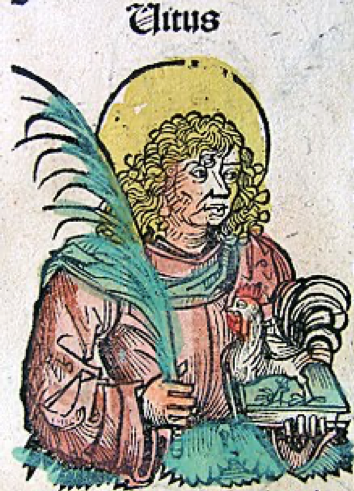
Saint Vitus, from the Nuremberg Chronicle, 1493, from Wikipedia, link 1. Shown with the rooster.
Website Sources:
This is the Wikipedia entry for Vitus. There were helpful links at the bottom, besides general information such as dates and information on future veneration.
This website has a database of information on various saints. It has a profile with a detailed account of his story, miracles, and martyrdom. It also has a list of patronage, with a couple references to his cult in medieval times.
This website has a nice little article about Vitus, written from a Catholic perspective. It references something called St. Vitus’ Dance, which is a medical condition and disorder, derived from his historical cult. It gives a slightly different account of his martyrdom than the previous website, but they parallel. It gives a lot of detail on his medieval cult and churches dedicated to him, along with a couple strange prayers and legends.
The Treasury of St. Vitus Cathedral Wikipedia page gives a bit of information on the cathedral named after Vitus in Prague where his arm is kept.
Good short summary of his life, but I used it for the picture.
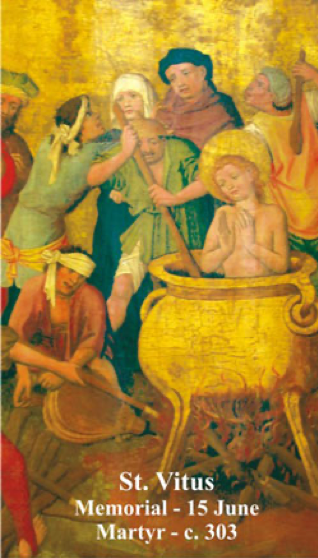
St. Vitus, from catholic.org.
Medieval Commemoration and Veneration:

 The Cult of Reagan