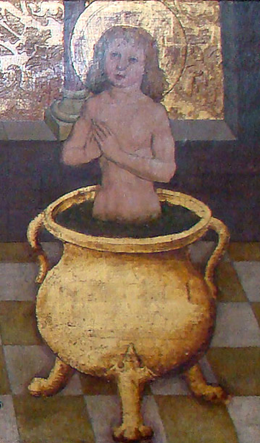
Martyrdom of Saint Vitus, Germany circa 1515, St. Vitus church, Flein. From Wikipedia, link 1
Martyrdom:
St. Vitus was martyred under the co-reign of Diocletian and Maximian. He himself was from Sicily, born around 290, and he was the son of a Pagan senator. At age twelve, he was converted by his tutor, St. Modestus, and his nurse, St. Crescentia. The conversion enraged his father, who had them arrested and tortured. Miraculously, the three were rescued from prison by angels. They went to Rome, and Vitus expelled an evil spirit from Diocletian’s son. Afterwards, Vitus refused to sacrifice to the pagan gods, and he was labelled a sorcerer and arrested. The story of his death is a bit fuzzy; there are two versions I have found. In one, he was boiled in lead, but it only seemed like a bath. He was then thrown to the lions, but they would not eat him, and merely licked his feet. He eventually died from the torture- even though the lead had not hurt him. In the other version, he was first thrown to the lions, and they did not touch him. Then he was thrown into hot oil, with a rooster (such was the custom to deal with sorcery). Additionally, I located a picture of his martyrdom that shows what looks like he is about to be beheaded by the sword. I did not encounter a written narrative with beheading, but the image exists. When he and the others with him died, a large storm came and destroyed pagan temples in the area. He died in 303, at the age of twelve or thirteen. His feast day is June 15 and he remembered as one of the Fourteen Holy Helpers.
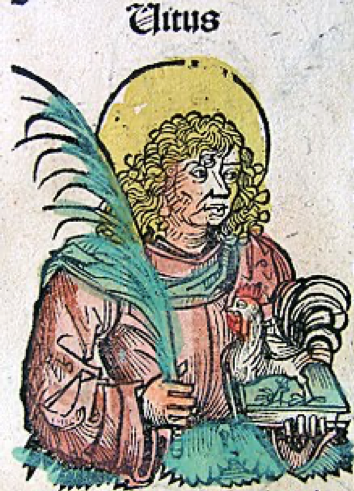
Saint Vitus, from the Nuremberg Chronicle, 1493, from Wikipedia, link 1. Shown with the rooster.
Website Sources:
This is the Wikipedia entry for Vitus. There were helpful links at the bottom, besides general information such as dates and information on future veneration.
This website has a database of information on various saints. It has a profile with a detailed account of his story, miracles, and martyrdom. It also has a list of patronage, with a couple references to his cult in medieval times.
This website has a nice little article about Vitus, written from a Catholic perspective. It references something called St. Vitus’ Dance, which is a medical condition and disorder, derived from his historical cult. It gives a slightly different account of his martyrdom than the previous website, but they parallel. It gives a lot of detail on his medieval cult and churches dedicated to him, along with a couple strange prayers and legends.
The Treasury of St. Vitus Cathedral Wikipedia page gives a bit of information on the cathedral named after Vitus in Prague where his arm is kept.
Good short summary of his life, but I used it for the picture.
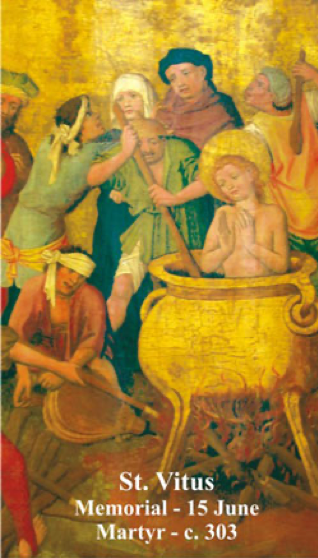
St. Vitus, from catholic.org.
Medieval Commemoration and Veneration:
- His relics were brought first to Paris in 756 AD and then to Germany in 836.
- His arm was gifted in 925 AD to Wenceslaus by king Henry I of Germany.
- This created a huge following for Vitus in Prague
- During the Black Plague, some Germans started dancing violently
- This is said to have happened on his feast day
- It was so bad it was confused with chorea
- People offered prayers to him to allay the dancing plague
- This is how he became one of the fourteen holy helpers
- Chorea, a neurological shaking/jerking disorder, is also called St. Vitus’ Dance
- There is a saying “If St. Vitus’ Day be rainy weather, it shall rain for thirty days together”
- This stems from the storm that occurred after his death
- He has patronage of dancers, actors, against oversleeping, against storms, against rheumatic chorea, Czech Republic, and epileptics.
 The Cult of Reagan