My saint is St. Edmund, also called Edmund the Martyr or Edmund of East Anglia. Although little contemporary work survives in the modern day on Edmund due to Viking raids and later the Dissolution of the monasteries, some work still survives due to his importance. He was a prevalent saint, considered to be the patron saint of England during the Middle Ages. He is first mentioned in an annal of the Anglo-Saxon Chronicle twenty years after his death. He is supposed to be the son of Æthelweard, though there is debate on who his father was or what royal lineage he was part of. He is supposed to have died on the 20th of November, 869.
There is not a perfect consistency to his depiction, though certain themes are common. In hagiographical art, these small motifs are important to clue people in to know which saint they are looking at. It was interesting to see how these depictions both varied and stayed consistent across time and place.
I found a number of depictions of St. Edmund from various time periods of history. These incredible pieces show different versions of Edmund- saint, martyr, king. The first work I found was an illumination from a medieval manuscript.
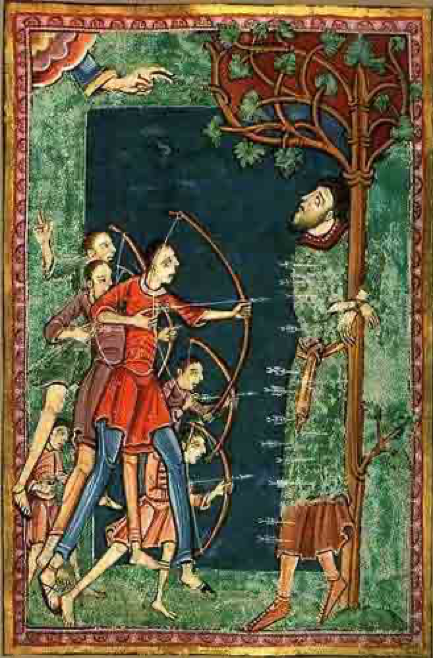
St. Edmund is pictured helpless, tied to a tree, with a dozen arrows protruding from his body from his assailants. He is looking up towards heaven, and hands can be seen reaching down. He is wearing a simple green cloak with a purple-y collar. Perhaps the purple shows his royalty, but all in all, what is emphasized here is humility, not royalty. I was not able to find a place, date, or author from this piece.
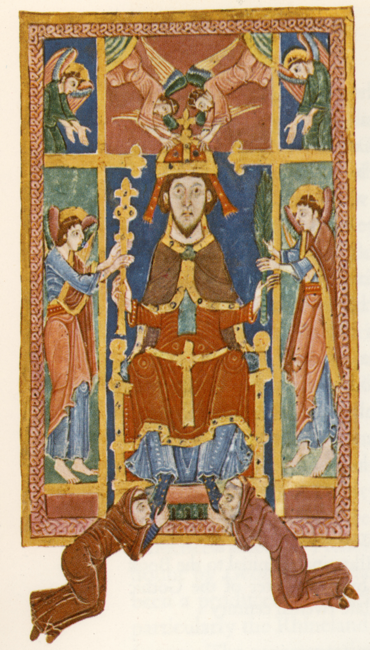
This second depiction of St. Edmund is wildly different from the first one. It is called “St. Edmund the Martyr crowned by angels”. This piece comes from a manuscript of Bury St. Edmunds (a church dedicated to him in Bury), around 1130. In this work, Edmund is surrounded by angels and gold. He has a magnificent crown and what looks like a bejeweled scepter, sitting on a throne. It emphasizes so heavily his regality and power, and even his God-given role as ruler.
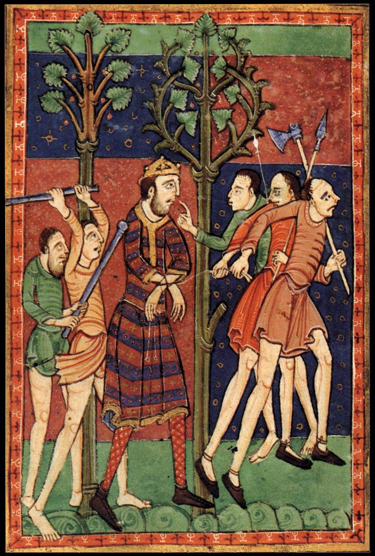
This third depiction is similar in some ways to each of the prior ones. The scene is of part of his martyrdom, like the first one, though it shows him right before his beheading rather than being shot with arrows. His hands are bound, just like before, and his demeanor and expression still show humility. Still, he is shows with gold on his tunic, and he is wearing his crown. His clothes are embroidered, and it shows his status as king as well as martyr. It is from Bury around 1130.
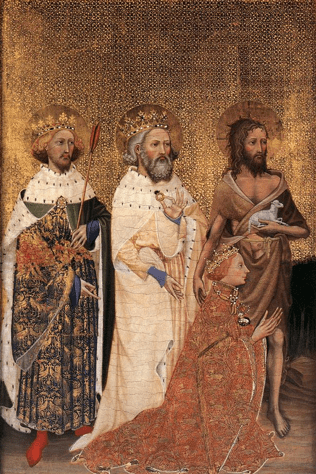
This image depicts Edmund alongside Edward the Confessor, John the Baptist and Richard II. He is differentiated not by his crown (three of them are royal), but by the single arrow his left hand is clutching. This is called the Wilton Diptych, from 1395, painted as a portable altarpiece for King Richard II by a Frenchman.
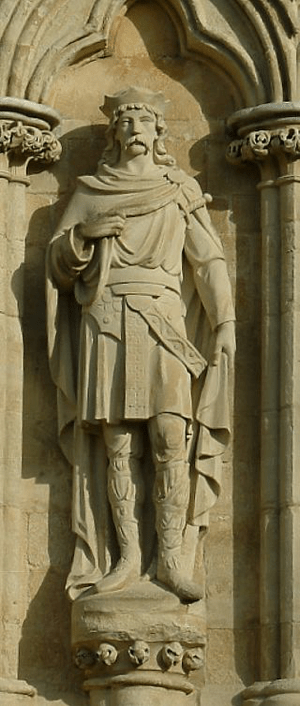
This stature is from the West Front of Salisbury Cathedral. It shows plainly to the common man Edmund’s regality. I could not find a date, but many of these statues on the West Front are from the 1800s.
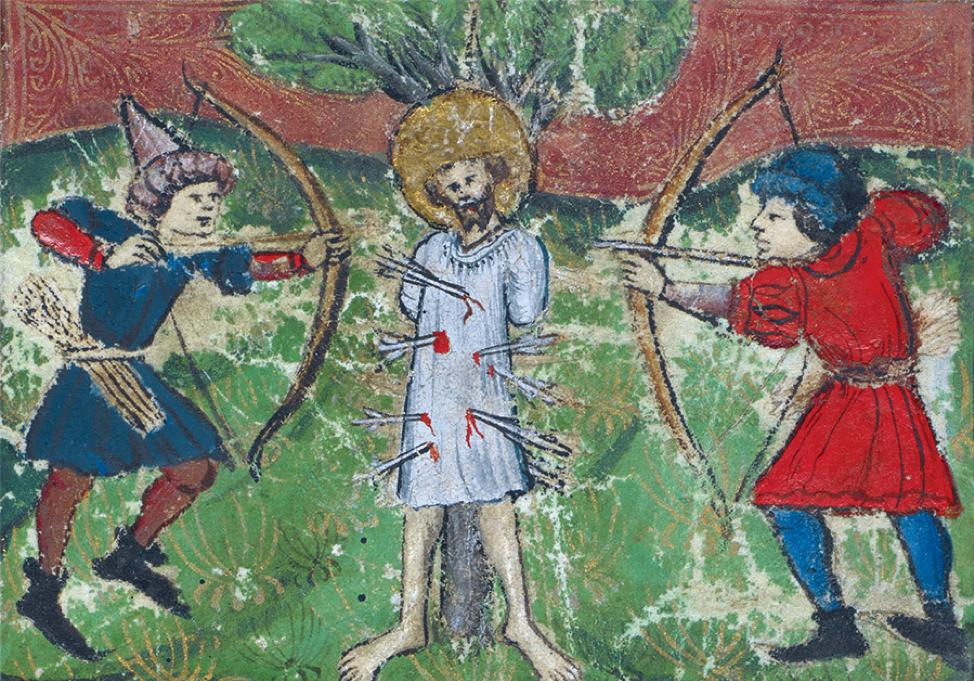
This is miniature is from c.1450. He has a plain undergarment, peppered with arrows, and a nimbus. I cannot tell if there is a crown due to the fade.

Here is a typical Orthodox icon of St. Edmund. The crown, sword, and cloak show him as king, and he is shows with the arrow.
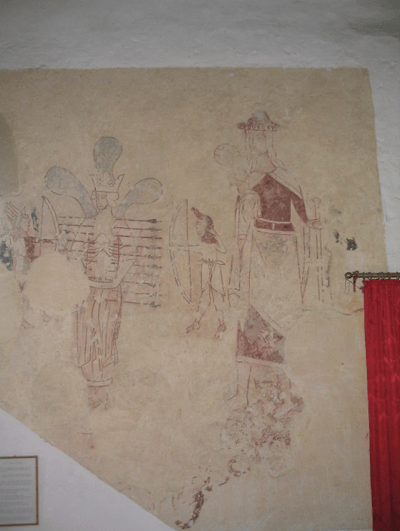
Here is a depiction of Edmund’s martyrdom with a wall painting at Stoke Dry, in Rutland. You can see the crown and the arrows, despite the weathered stone.
 The Cult of Reagan